
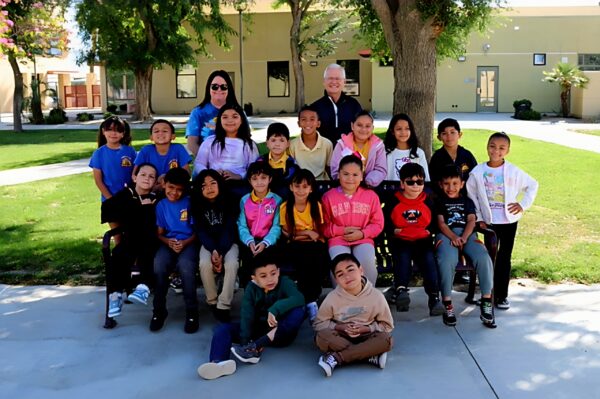
DID YOU KNOW that a retired Saskatchewan King’s Bench Justice spends his winters in California helping Grade 2 children learn to read, and that a Coachella Valley school district has honoured him as Volunteer of the Year for that work?
Retired Justice Dennis Ball of Regina, Saskatchewan, inducted as a fellow in 1998, has spent a lifetime thinking about how law can give people a fair chance. Now, at 80, he spends one morning a week in a classroom in a low-income neighborhood in the Coachella Valley, quietly working on something even more basic than legal rights. He sits at a tiny table with seven year olds, many of them from Spanish speaking families, helping them sound out English words and talking with them about their lives.
Ball and his wife have been spending winters in California for about 15 years, and have owned a home in Palm Desert for roughly 13 of those years. Like many snowbirds, he joined a local golf club, Indian Ridge. Unlike many, he accepted an invitation from one of the members to try something beyond the fairways.
“There is one of the other members of the golf course I belong to, it is called Indian Ridge in Palm Desert, who had been encouraging us to volunteer for this organization called Read with Me,” Ball explains. “There were two or three other members of the club who were doing that, and spoke very positively about it, and I thought, you know, it works for me, so I volunteered, and the more I have done it, the more satisfying it became. These children really, really appreciate it, appreciate the attention they receive….”
Read With Me Volunteer Programs is a Coachella Valley nonprofit that recruits and trains volunteers to provide English language tutoring in elementary schools serving children from low-income, limited English speaking families. Its mission is “to assist children from a low-income, limited English speaking environment develop to their fullest potential by learning to read, comprehend and speak English, while understanding that people care about them as individuals.”
The program began in 2004 at Mecca Elementary and has grown to more than 500 volunteers who tutor over 4,200 children in more than 20 schools across the Coachella Valley. Volunteers typically commit one or two hours a week, working under the direction of teachers to help students with reading, pronunciation and comprehension. The program also purchases and distributes approximately 35,500 books each year so that about 10,000 students can take books home and begin building family libraries.
The impact of his work came when he noticed materials in the Coachella school office on legal rights. They were written in English. The cards were a reminder of something access to justice scholars now stress. Rights written on paper are of little use if no one in the household can read them or has the confidence to act on them. By helping children become comfortable with English sentences at age seven, Ball is working at the very front end of what it means to make rights a reality.
From the standpoint of the American College of Trial Lawyers, whose mission includes a strong emphasis on access to justice, this is a classic upstream intervention. Reading with Grade 2 students in a high immigration, low-income district helps build the basic literacy and confidence those children will need to understand school notices, employment contracts, government forms, and other legal rights later in life. It indirectly supports the rule of law.
There is a symbolic dimension as well. Ball is a Caucasian, retired Canadian superior court judge sitting in a classroom full of Hispanic children, many from families who live in Mexicali. His presence signals that allyship is based on principle, not on nationality or race.
The American College has increasingly called on Fellows to match excellence in advocacy with service, mentoring and community engagement. Ball’s story is a vivid example of what that can look like in the later stages of a career.
“I have always believed that literacy, the ability to read and write, is the first instrument you need, the first capacity you have to have before you have any chance of succeeding in society,” he said.
Brian Pfefferle, K.C., Heritage Committee Member
Saskatoon, SK