
Ethical Dilemmas of the Trial Lawyer
Your guide to the questions and answers encountered as an ethical trial lawyer.
Presented by the Legal Ethics and Professionalism Committee
Trial practice often presents difficult ethical questions that do not lend themselves to easy answers but still require quick decisions, sometimes on the fly or in the heat of battle. This series of anecdotes is designed to help you navigate those challenges by offering clear, practical guidance grounded in professional responsibility, professionalism and practical judgment based on long and collective experience.
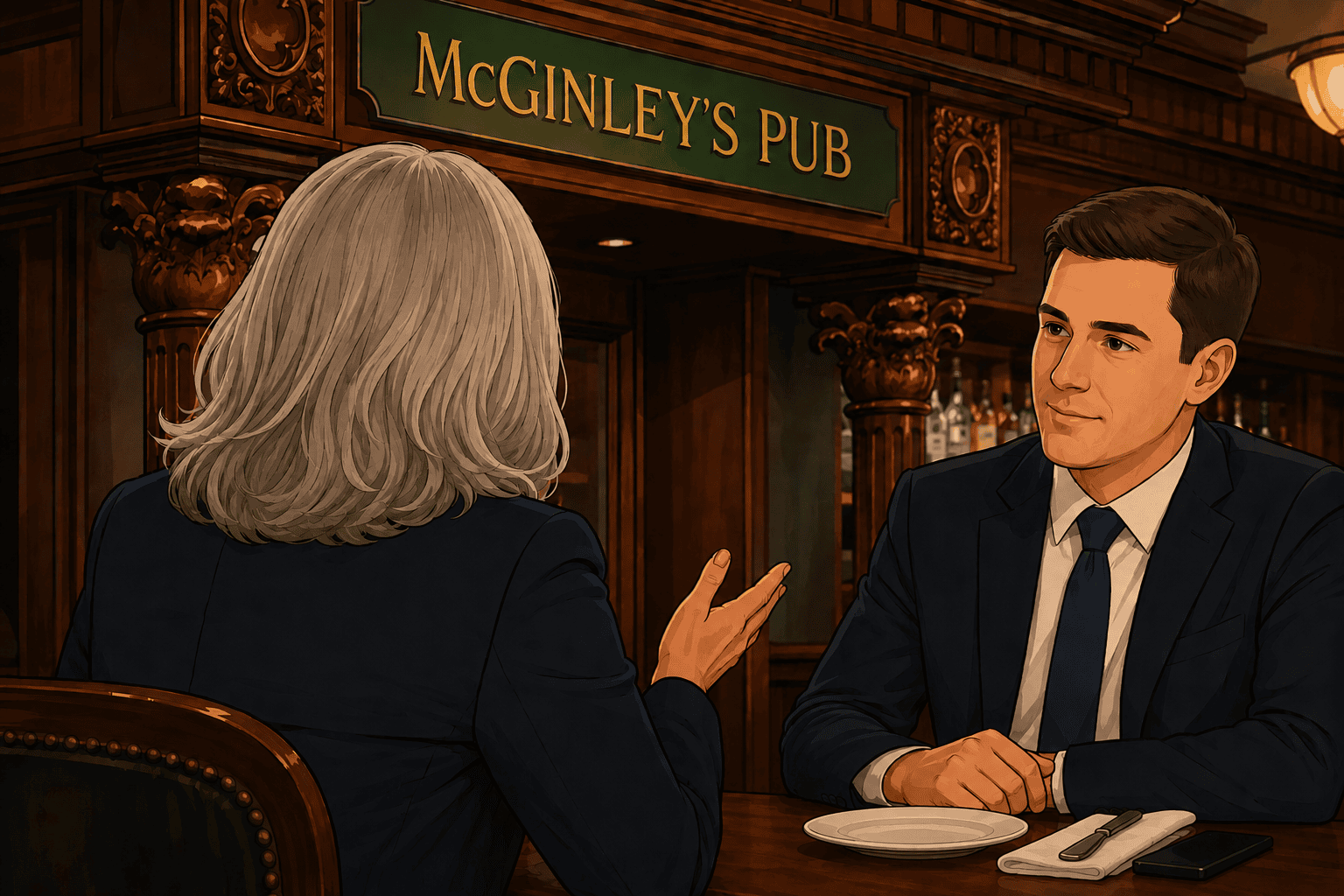
Founded in 1950 by Emil Gumpert, the American College of Trial Lawyers is dedicated to upholding the highest standards of professionalism, civility, and ethics in trial law. In that tradition, these pieces feature “Emily,” a fictional, highly respected trial lawyer from a mid-sized U.S. community whose advice is sought by attorneys – and occasionally judges – on legal ethics, professionalism, and sound trial practice. We like to think that she would be a Fellow of the College.
Emily holds court at the Lawyers’ Table in McGinley’s Pub, a local tavern near the courthouse frequented by attorneys before and after proceedings – and often during breaks. She has been a fixture there for more than forty years.
The Committee plans to expand this series regularly and encourages Fellows to offer comments, suggest edits, and submit or propose new pieces. Please email either or both of our co-editors, John Jackson (jjackson@greenbaumlaw.com) and Craig Woods (cwoods@woodslawdr.com), with your comments or submissions.
Emily was finishing her coffee when Robert Bruce appeared at the end of the Lawyer’s Table. “Before you leave, Emily, could I have a minute?”
Emily knew the conversation would likely last more than a minute, but she cheerfully said, “Sure. Let me get another cup of coffee for our conversation,” Signaling a waiter, she added, “Do you want anything?”
“No, thanks. I am representing a non-profit corporation in a land use dispute. A large number of technical witnesses have been presented, and we are in the middle of our case-in-chief. One of my consultants is an expert in zoning and planning, an experienced witness, and has provided a detailed report. I had planned to call him to the stand, but as the trial developed, I am now of a mind not to call him.”
“What are you concerned about?” Emily asked as the waiter came to refill her coffee cup.
“Several things. I re-read my expert’s report last night in light of the evidence we have already put on. While the report contains information and opinions helpful to our position, the expert makes numerous engineering assumptions that no engineer in the case supports. He claims, for example, that the exposed basement wall poses a risk of building collapse – but no engineer has said this, and he has no factual basis for these conclusions. I was concerned about this before, but our case has gone in pretty well so far, and I now know that opposing counsel is sharp enough to recognize the problem. I thus fear that our expert will be severely discredited on cross-examination. This will needlessly damage what is otherwise a very strong case on environmental and safety grounds. In my opinion, we do not need his testimony and putting him on the stand will be risky at best.”
“Makes sense to me. So, what is troubling you?”
“The president of the non-profit group is pressing to have him testify. I have explained in detail the weaknesses and potential ramifications of this expert testimony. I have met both with the president and the board of trustees. Most, if not all, of the board members seem to agree with me.”
Emily took one more sip of coffee and then said, “Your matter presents an issue of the allocation of authority to decide. Model Rule 1.2 lays out clearly that “a lawyer shall abide by a client’s objectives concerning the representation.” However, it draws a distinction between the objective of the representative and the means by which those objectives are to be pursued. The rule suggests that the lawyer “shall consult with the client” on such issues, but the Comment notes that clients normally defer to the special knowledge and skill of their lawyer with respect to the means to be used to accomplish their objectives, particularly with respect to technical, legal and tactical matters. There is substantial case law recognizing that the power to decide questions of trial strategy and tactics ultimately rests with counsel. One such tactical-strategic decision concerns counsel's determination of which witnesses to call and what evidence to present. See, e.g., Schaffer v. Thompson, 303 So.3d 159, 163 (Ala. Civ. App. 2020), aff’d, 389 So.3d 1100 (Ala. 2023).
“I think you are on firm ethical ground here, Robert. As I mentioned, there is plenty of support for the notion that you, as lead trial counsel, have the authority to make the call whether or not to put the expert on at trial. You may also be able to argue that your client’s board had the authority to overrule the objection by the president of the organization. Still, your decision, even if ethically correct, may be subject to second-guessing by the president and others if the case goes poorly. You may thus want to run this by your firm’s loss prevention counsel.”
Entering McGinley’s Pub three blocks away from the county courthouse, Emily took her usual seat at The Trial Lawyers’ Table. As other attorneys gathered for lunch and started filling the seats at the table, young Jimmy Day sat down across from Emily.
“Emily, I hope you can give me some guidance.” “I certainly will try. I am listening.”
“I filed suit for a client Monday seeking, among other things, a TRO as interim relief. I gave the defendants notice of the immediate hearing on the motion to take place tomorrow. They retained an attorney who called me and said he knows nothing about the case yet, but he would be in court. This is my question: In making my argument to the court, do I have an obligation to inform the court and opposing counsel of material facts that could run against my effort to secure a TRO?”
Emily picked up her glass of ice water, sipped it thoughtfully, and began to talk.
“Your question calls into play the provisions of Model Rule 3.3(d). This Rule provides that in an ex parte proceeding, a lawyer must inform the tribunal of ‘all material facts’ known to the lawyer that will enable the court to make an informed decision, ‘whether or not the facts are adverse.’ In your case, because you gave notice to the defendants and they arranged for counsel to appear at the hearing, this is not an ex parte proceeding. Therefore, you have no obligation under Rule 3.3(d) to disclose all facts adverse to your request for relief and may safely argue your side of the matter.”
Jimmy McGee sighed in relief and settled back into his chair.
“Not so fast,” continued Emily. You still have the obligation to make sure you do not knowingly make a false statement in violation of Rule 3.3(a)(1). From the point of good strategy and sound professionalism, moreover, you might also want to consider whether it is wise not to disclose up front any important fact that is eventually going to come to light anyway. Among other things, maintaining your credibility with the court in this matter and others is important to both you and your clients.”
As Emily sat at The Trial Lawyers’ Table, she had just started looking over the menu when Larry Harriman hurried up to her. In a low voice, he said “Emily, I think I have a problem. Can I talk with you?”
“Sure. Have a seat.”
“I can’t stay for lunch and need to use the recess to work something out. I am trying a civil case before Judge Van Sciver. The case will turn on a critical accounting issue at the company I am defending. During the case workup and my trial prep session, a high-ranking corporate officer and important witness told me she did not remember if she became aware of a key issue before or after a sale of the stock in question. During my direct examination at trial, I did not ask her about that timing issue, but on cross-examination she testified definitively that she is certain the issue only came to light only after the stock sale. Do I have an obligation to disclose the earlier statement to the court or the opponent? What do I do?”
Emily set the menu aside and leaned forward, speaking quietly.
“Model Rule 3.3 protects the integrity of matters before a ‘tribunal,’ and bars a lawyer from offering evidence the lawyer knows to be false. It further requires the lawyer to take ‘reasonable remedial measures’ if a witness offered by the lawyer gives ‘material’ testimony or other evidence the lawyer has come to know is false.
“In the situation you’ve described, the testimony sounds as if it is clearly material. Thus, the remaining question is whether the lawyer ‘knows’ the testimony to be ‘false.’ Model Rule 1.0(f) states that ‘knowingly’ denotes ‘actual knowledge of the fact in question.’ The apparent inconsistency with her prior statement certainly is an indicator of falsity, but there could be another explanation for the change in her story.
“Before taking any action, the best practice is to ask the witness about the change in her answer. Maybe something in the course of the trial or otherwise has refreshed or jogged her memory in a different direction. If, after that conversation, you remain convinced that the testimony is false, you have a duty to take ‘reasonable remedial measures.’ These should begin by urging the witness to agree to correct her own testimony, pointing out both the potential consequences of false testimony and the lawyer's obligations. You have a recess; take advantage of it. If you didn’t, you should ask for a recess to talk with the witness.
“If this effort is unsuccessful, you must disclose the facts to the court if necessary to correct the false evidence. To the extent that the witness is viewed as the client, Rule 3.3(c) makes it clear that this disclosure is required notwithstanding the duty of confidentiality under Model Rule 1.6.”
Longshanks stood up and said, “I’ll go find her now.”
Emily held up a hand, adding: “One more thing, Larry. There is a circumstance that can become rather sticky. In our jurisdiction, we don’t have a general prohibition on a lawyer conferring with a trial witness from the time testimony begins until it is completed. However, in some trials, individual judges do enter such restrictions. The United States Supreme Court in Villarreal v. Texas, 146 S.Ct. 756 (2026), recently upheld the constitutionality of this kind of order to prevent improper coaching of a witness. So, if such an admonition is in place here, you may have to ask for dispensation to inquire about ‘something related to professional responsibility concerns’ and hope the court does not try to probe too deeply into the issue.”
“And while we’re at it, for future reference, keep in mind that Rule 3.3(c) is applied differently to criminal defendants. In many jurisdictions, the expected false testimony of a criminal defendant may be offered in another way, such as by narrative rather than specific questions posed by the lawyer.”
“Better hurry,” she said with a wry smile. “Good luck. Now leave me to my lunch.”
It was time for another lunch at The Trial Lawyer’s Table. Emily was enjoying her bowl of split pea soup when Rich Murphy said, “Let me ask you about a cross-examination tactic.”
“Go right ahead,” said Emily, who continued to fill her soup spoon.
“Hypothetically, I impeach a witness on cross-examination by repeatedly highlighting testimonial inconsistencies with his deposition. I am successful to the point where I can simply pick up the transcript, he recants and withdraws the answer he has just given. Having thus conditioned the witness, can I then proceed to ask a question implying a contradiction in the transcript I am holding when I know that there was no discussion of that topic in the deposition?”
Emily discreetly raised her napkin to wipe off a little soup that had spluttered out as she listened to Rich.
“You are navigating a tricky course through the shoals of several different Rules. They include the Rule 4.1 obligation of truthfulness in statements to others, the Rule 3.3 requirement of candor toward the tribunal, and the Rule 8.4 demon of misconduct arising from conduct involving dishonesty, deceit, or misrepresentation. Conveying to a jury that a document in your hand has contradictory assertions when you know it does not is a problem. There’s a point when bluffing crosses the line. Sometimes it is not bright or easy to see.
“For example, the Ohio Supreme Court held it was professional misconduct for an attorney to imply during a deposition that she had recorded conversations that could impeach and would embarrass the witness when no such recordings existed. In Cincinnati Bar Ass’n v. Statzer, 800 N.E.2d 1117 (Ohio 2003), during the questioning, the lawyer, with several unrelated cassette tapes on the table in front of her labeled with dates that covered the incidents at issue, asked questions referring to the tapes, implying that the tapes would impeach her testimony. The court concluded that this was deceitful conduct.
“This practice is sometimes referred to as phantom impeachment. It has its critics, but also a few defenders. A safer course of action in that case might have been to ask: ‘if we had recordings of those conversations, would they be consistent with your testimony today?’ In your situation, it might be better to ask if the answer is consistent with what the witness testified to at his deposition.”
Emerald green hues dominated the décor of McGinley’s Pub. The Lawyers’ Table had two vases on it filled with white flowers and large bunches of greenery. Emily selected the Dublin coddle from the St. Patrick’s Day menu along with an order of Irish soda bread. She was smoothing the napkin on her lap when Jack O’Shaughnessy sat down next to her.
“Top of the morning to ya, Emily,” he said.
“And the rest of the day to you, Jack,” she responded.
“I won’t be staying for lunch, but I was hoping I might have a quick word with you.”
“But of course.”
“I have been in trial this week defending a medical malpractice claim against an Ear, Nose & Throat specialist. He did a vocal cord stripping procedure on a woman who suffered from polyps. She claims that following the surgery, her voice became hoarse, ultimately so low and soft that she had difficulty conversing normally.
“When she testified earlier this week, it was hard to make out what she was saying – so much so that I briefly thought about quoting the passage from Shakespeare’s King Lear that a voice ‘ever soft, gentle and low [is] an excellent thing in women’. I thought better of it, though.”
Emily sat up in her chair, nodded sympathetically, and with some effort, said: “You certainly made the right call there.”
O’Shaughnessy continued. “Plaintiff’s counsel engaged a very prominent physician who provided an opinion criticizing my client’s decision to recommend the surgery. The expert would not come to court but did agree to a video deposition. The video was played this morning.
“On cross, I was able to get many supportive concessions. The expert’s video was the last witness for the plaintiff. Shortly thereafter, plaintiff rested. The judge decided we should take an early lunch break, so here I am.”
Emily shrugged her shoulders. “So, what’s the problem?”
“Well, while I was in the hallway waiting for my client to come back from using the bathroom, the plaintiff came up to me by herself. She began complaining about what I had done during the expert’s testimony. I quickly told her that I could not speak with her and I politely suggested that she get her lawyer. She persisted, though, complaining bitterly about how much money she had had to pay for his deposition. As she became more agitated, unlike in the courtroom, her voice grew louder and louder. Clearer too. Pretty much normal.”
At this point, O’Shaughnessy paused. “I’m pretty sure that if the jurors heard how strong her voice was in that moment, they would be very skeptical about her claims. What can or should I do about this?”
Emily was now paying close attention. “Did anyone else witness this exchange?”
“No. And her lawyer had already left the courthouse.”
Emily looked directly at O’Shaughnessy and said, “It’s good that you cut off the conversation when you did. But there’s more to think through.
“ABA Model RPC 4.2 states: ‘In representing a client, a lawyer shall not communicate about the subject of the representation with a person the lawyer knows to be represented by another lawyer in the matter, unless the lawyer has the consent of the other lawyer or is authorized to do so by law or a court order.’ Violation of RPC 4.2 has been held to be grounds for disqualification and other professional discipline. See, e.g., Shelton v. Hess, 599 F. Supp. 905, 911 (S.D. Tex. 1984); Matter of Herkenhoff, 116 N.M. 622, 624, 866 P.2d 350, 352 (1983).
“For more than sixty years, the American Bar Association has taken the position that a client may not waive the protections arising from ethical responsibilities of the communicating lawyer. Well, before the adoption of the Model Rules, the ABA Commission on Ethics and Professional Responsibility, Formal Opinion 108 (1934) concluded that the anti-contact rule does not contemplate a client's waiver of its protection. In Curley v. Cumberland Farms, Inc., 134 F.R.D. 77, 87 (D.N.J. 1991), the interests protected by RPC 4.2 were described as (1) preventing adverse counsel from taking advantage of a represented party through ex parte contact; (2) protecting the represented party's right to effective representation; and (3) promoting ethical behavior on the part of attorneys.
“In a more recent formal opinion, the ABA Committee noted that courts across the country continue to find that ‘because the ethical prohibition is designed, in part, to protect the effectiveness of the lawyer's representation, the represented person may not waive it.’ ABA Comm. on Ethics and Professional Responsibility, Formal Op.95–396 (1995). In re News Am. Pub., Inc., 974 S.W.2d 97, 102–03 (Tex. App. 1998), subsequent mandamus proceeding sub nom. In re Users Sys. Servs., Inc., 22 S.W.3d 331 (Tex. 1999).
“Official Comment 3 to RPC 4.2 indicates that ‘[t]he Rule applies even though the represented person initiates or consents to the communication.’ This same prohibition is found in Restatement (Third) of the Law Governing Lawyers § 99 (2000). Comment f states: ‘the anti-contact rule applies to any communication relating to the lawyer's representation in the matter, whoever initiates the contact and regardless of the content of the ensuing communication.’ Guidance for this situation can be found in Comment 3 to RPC 4.2 that ‘[a] lawyer must immediately terminate communication with a person if, after commencing communication, the lawyer learns that the person is one with whom communication is not permitted by this Rule.’”
Emily looked directly at O’Shaughnessy, who seemed mesmerized and not a little shell-shocked at the depth of her knowledge of the subject, and said: “You did exactly the right thing by terminating the conversation. Well done.”
O’Shaughnessy shrugged his shoulders and said, “But I sure wish there was a way to let the jury know about what happened. What, if anything, can I do?”
“This was an unwitnessed encounter, and you don’t want to make yourself into a witness.” Emily smiled. “But wouldn’t it be interesting if she went back onto the witness stand in a rebuttal case and you had the chance to cross-examine her? Perhaps you could goad her into a repeat performance.
“You might also ask to speak with the judge before the jury returns to the courtroom. In the presence of the plaintiff’s counsel, you could describe the encounter with the plaintiff. Maybe the judge will be bothered enough to give you another chance to question her, though it is equally likely that with the trial well underway, the court will take no action. But recognize that having been tipped off, there is a chance that your opponent will do everything possible to avoid putting his client back on the stand.”
There was only one open seat at the Lawyers Table when Emily got to McGinley’s Pub. Unlike her usual seat at the far end, this seat placed her right at the center of the table. Jackie Morris was sitting across from her. She was starting on her Caesar salad when she looked at Emily and smiled.
“A funny thing happened to me on the way over here from the courthouse. I got an email from an opposing lawyer with whom I am in trial. It looks like he inadvertently forwarded an email to me in reply to a representative of his client, a large company. Before I realized that the email was not meant for me, I read his recommendation that given some problems with the expected testimony of a couple of their witnesses, the client should accept our current settlement offer.
“What are my obligations here? I think there was an ABA opinion that said I couldn’t keep or use this information. Is that still the rule? Am I supposed to destroy or delete this now? Do I tell him I received it? Can I and should I pass the info along to my client? It's pretty material to whether we leave the settlement offer on the table or withdraw it.”
Emily smiled as she smoothed the napkin on her lap. “Your long-term memory is in pretty good shape, Jackie. Issued in 1992, ABA Formal Opinion 92-368 set forth three steps a lawyer had to follow upon receiving privileged information that was inadvertently sent. Those steps were: (1) refrain from further examination of the material; (2) notify opposing counsel of their receipt; and (3) abide by opposing counsel's instructions concerning disposition of the materials. The Opinion imposed the primary duty on the receiving lawyer. It was criticized for not being based on any explicit provision in the Model Rules.
"In 2000, the ABA amended the Model Rule 4.4 concerning the rights of third persons. It added a new paragraph (b) addressing a lawyer's duty upon receipt of inadvertently disclosed but otherwise privileged information. Under the amended Rule, when a lawyer knows or reasonably should know that privileged information was inadvertently disclosed, the lawyer has a duty to ‘promptly notify the sender.’ Comment 2 to the Rule indicates that the notification requirement is to permit the sender ‘to take protective measures.’ And Comment 3 notes that some lawyers may choose to return or delete the inadvertently sent email, but this is a matter of professional judgment reserved to the receiving lawyer. In 2005, with Formal Opinion 05-437, the ABA formally withdrew Opinion 92-368 and referred to the provisions of amended Rule 4.4.
“The ABA Model Rule 4.4 views much of what happens next, or determining the possibility of waiver of privilege, as being outside the scope of the Rules of Professional Conduct. It is thus necessary to look to other law such as the Federal Rules of Civil Procedure with the ‘clawback’ provisions in F.R.Civ.P. 26(b), local rules, or relevant pretrial orders.
“Some states have modified their versions of Rule 4.4(b) to provide more specific directions to, or restrictions on, receiving counsel. For example, in New Jersey, a lawyer receiving a document or information that was inadvertently sent shall not read it or, if he or she has begun to do so, shall stop reading it. The lawyer shall (1) promptly notify the sender, (2) return the document to the sender and, if in electronic form, delete it and take reasonable measures to assure that the information is inaccessible.
“As you know, our court’s local rules do not speak to this issue, and our state has adopted the Model Rules verbatim. Accordingly, your most important obligation is to promptly provide the notice Rule 4.4(b) requires to your opponent. The next step, if any, is his.
“Rule 4.4 is grounded in the notion of civility. It gives your opponent the opportunity to confirm the inadvertent disclosure, seek protection of the information, and to raise with you any consequences that may ensue. If your adversary takes no action, that will likely waive any protection from disclosure and give you some peace of mind as well.
“So finish your lunch and give notice to opposing counsel.” And with that, Emily picked up the menu to order her own lunch.
Please note that these pieces and any conclusions drawn within them are meant to be thought-provoking but are not necessarily definitive or all-encompassing in terms of authorities referenced. Of necessity, Emily’s observations and conclusions are based largely on the ABA Model Rules of Professional Conduct. The Model Rules, however, have often been adopted in different or amended versions, and they are interpreted in different ways by different courts and jurisdictions. Always check the rules and authorities applicable in your relevant jurisdiction – the conclusion may be completely different.
Finally, these pieces do not yet reflect the applicable law and authority of Canda, but we hope they will in the future. We certainly welcome any assistance we can get in that regard from our Canadian Fellows.