
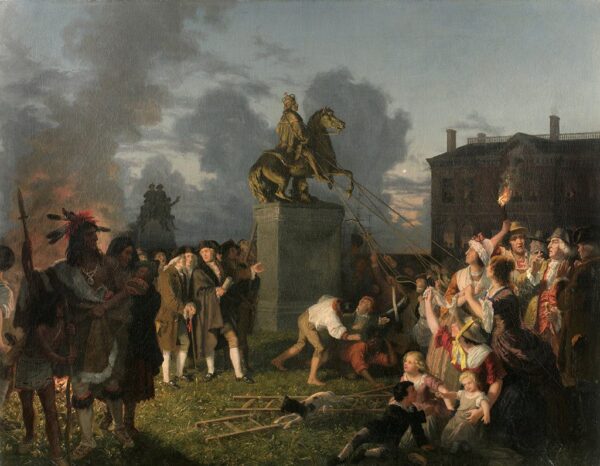
DID YOU KNOW that it was almost exactly 250 years ago that New York City found itself at the center of the American Revolutionary War? Fittingly, the College’s 76th Annual Meeting will be held in New York this October. Back in the summer of 1776, the Declaration of Independence was delivered to General George Washington and his army as they defended the city. While things did not go particularly well for the fledgling nation in New York immediately thereafter, 250 years later we have much to celebrate – and New York City is the perfect place to do so.
Just over seven years after the Americans lost New York City to the British, the British left. The evacuation was agreed to by Generals Washington and Sir Guy Carleton (Sir Henry Clinton’s replacement) and set to occur on November 25, 1783. The American troops approached Manhattan from their camp on the Hudson and discovered a wasteland. There was no autumn foliage, and few structures of note remained. Everything that could be burned had been used for fuel by the British. The mansions belonging to Patriot leaders had been ruined by British officers. Another third of the city’s buildings were destroyed by fire in 1776 and a huge area of town was now nothing but charred timbers and blackened chimneys, the derelict remains of what was once a vibrant seaport town.
The small American army lead by General Washington marched as far as the Battery, then waited for the British to withdraw. The redcoats lined up and headed to the wharves on the East River to await transport to the British ships in the harbor. Washington, mounted on a magnificent gray horse, was escorted by troops under General Henry Knox. They were followed by a corps of dragoons, light infantry, artillery and a battalion of Massachusetts men, each wearing a union cockade on his left breast and a sprig of laurel in his hat.
A New York spectator recalled that she and her friends had become accustomed to the British military display of finery, in scarlet uniforms and burnished arms, whereas the Americans marched into town “ill-clad and weather beaten and made a forlorn appearance; but then they were our troops, and as I looked at them and thought upon all they had done and suffered for us, my heart and my eyes were full, and I admired and gloried in them the more, because they were weather beaten and forlorn.”*
Fortunately, New York City, and particularly the Waldorf-Astoria, have vibrantly risen from that former wasteland – the former having recently completed a multi-billion-dollar renovation just in time for our Annual Meeting. We descend upon it significantly less weather beaten and forlorn, but still glorious in our own Spirit of ’76.
*Quotation cited in Douglas Southhall Freeman, George Washington in the American Revolution. Vol. 5 Victory with the Help of France, New York: Dodd, Mead, 1976, 462-63.
Kirk G. Warner, Heritage Committee Chair
Raleigh, NC